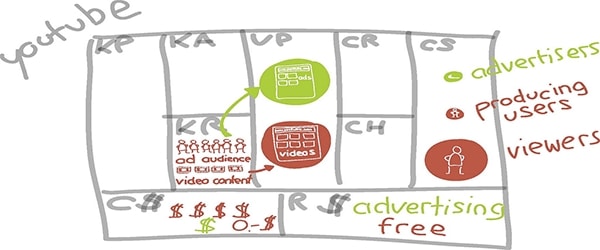
The Business Model Canvas is a one-page strategic tool that breaks any business down into nine building blocks: customer segments, value propositions, channels, customer relationships, revenue streams, key resources, key activities, key partnerships, and cost structure. Developed by Alexander Osterwalder, it lets an owner see how their business actually creates, delivers, and captures value, all on a single sheet instead of buried across a lengthy business plan.
Quick Answer: The 9 Building Blocks
- 1. Customer Segments — who you serve.
- 2. Value Propositions — what problem you solve, or need you satisfy, for them.
- 3. Channels — how you reach and deliver to those customers.
- 4. Customer Relationships — the type of relationship each segment expects.
- 5. Revenue Streams — how the business actually makes money.
- 6. Key Resources — the assets required to make the model work.
- 7. Key Activities — the most important things the business must do.
- 8. Key Partnerships — the outside relationships that make the model possible or more efficient.
- 9. Cost Structure — the costs that running the model incurs.
Where the Canvas Comes From
The Business Model Canvas comes from the work of Alexander Osterwalder, developed alongside Yves Pigneur and popularized in the book "Business Model Generation." Its appeal has never been theoretical elegance — it is that a business owner, a founding team, or an agency working through a new idea can fill in all nine blocks on a single page and immediately see where the model has a real gap: no clear channel to reach the customer segment, a cost structure that does not match the revenue model, key resources nobody has actually secured yet.
The 9 Blocks, One at a Time
1. Customer Segments
Who, specifically, are you creating value for? Not "everyone" — a real business usually serves one or a few distinct groups with different needs. A local outdoor retailer might serve winter skiers and summer bowhunters as two genuinely different segments with different seasons, different products, and different marketing that reaches each of them.
2. Value Propositions
What bundle of products and services creates value for each segment, and why would a customer choose you over an alternative? This is the block most businesses can state in a sentence but struggle to differentiate — the real work is being specific about what makes the value proposition genuinely different, not just "good service" or "quality work," which every competitor also claims.
3. Channels
How does the value proposition actually reach the customer — through what touchpoints do they learn about you, evaluate you, buy from you, and receive what they bought? A channel can be a physical storefront, a website, a partner referral network, or a marketplace. Most small businesses use several channels at once, and the canvas forces you to name each one rather than assume it is obvious.
4. Customer Relationships
What kind of relationship does each customer segment expect you to establish and maintain — self-service, personal one-on-one assistance, an automated but personalized experience, or an ongoing community? A healthcare practice and a self-checkout retail kiosk sit at opposite ends of this spectrum for good reason: the expected relationship shapes staffing, technology, and cost.
5. Revenue Streams
How does the business actually convert the value it creates into cash? One-time sale, subscription, usage-based fees, licensing, a service retainer — many businesses run more than one revenue stream at once, and this block forces clarity on which one actually funds the business versus which one is a smaller side stream.
6. Key Resources
What physical, financial, intellectual, or human assets does the business model require to work at all? A specialized piece of equipment, a skilled team, a location, a body of proprietary knowledge or reputation — these are the resources without which the other eight blocks cannot function.
7. Key Activities
What must the business actually do, consistently, to deliver its value proposition? For a service business this is usually the service delivery itself and the sales/marketing that fills the pipeline; for a product business it may be production, quality control, and distribution.
8. Key Partnerships
What outside relationships — suppliers, referral partners, strategic alliances — make the model work, reduce its risk, or make it more efficient than doing everything in-house? Few businesses of any size are truly self-sufficient across all nine blocks; naming the real partnerships is often where owners discover an unmanaged dependency.
9. Cost Structure
What does running this model actually cost, and which costs are fixed versus which scale with volume? This block should reconcile honestly with Key Resources and Key Activities above it — a model that requires expensive key resources but assumes a low-cost structure has a gap worth resolving before it goes further.
A Worked Example: A Local Coffee Roaster
Let's make this concrete with coffee. Picture a small local roaster — a cafe on the downtown corner, plus a wholesale account with three restaurants a few blocks over — and watch how the nine blocks actually fill in for that specific setup.
- • Customer Segments: café walk-in customers, and local restaurants buying wholesale beans.
- • Value Propositions: fresh, locally roasted coffee with a story customers can see and taste, plus reliable wholesale supply for restaurant partners.
- • Channels: the physical café, a website with online ordering, and direct restaurant sales relationships.
- • Customer Relationships: personal and community-driven for café regulars; account-managed and reliable for wholesale partners.
- • Revenue Streams: café sales, bagged retail coffee, and wholesale accounts — three distinct streams from one roasting operation.
- • Key Resources: the roasting equipment, the physical café location, and the roaster's expertise and relationships with green-coffee suppliers.
- • Key Activities: roasting, café operations, and account management for wholesale clients.
- • Key Partnerships: green-coffee importers, and the restaurants themselves as ongoing wholesale partners.
- • Cost Structure: fixed costs (lease, equipment, base staffing) plus variable costs (green coffee, packaging) that scale with both revenue streams.
Laid out this way, gaps become visible fast. If the wholesale relationships (a Key Partnership and a Revenue Stream) are concentrated in two restaurants, that is a real business risk the canvas surfaces immediately — one that a narrative business plan can bury in paragraphs.
How This Connects to Marketing
The canvas is a strategy tool, but three of its nine blocks — Customer Segments, Value Propositions, and Channels — are also the exact inputs a marketing plan needs before a single dollar gets spent. A business that has not clarified who it serves and why cannot brief an agency, write ad copy, or choose the right channels with any real precision. If you have filled out a canvas and want help turning the Channels and Customer Relationships blocks into an actual marketing plan, that is a natural next step — see our guide to marketing a business, channel by channel.
Frequently Asked Questions
Who created the Business Model Canvas?
Alexander Osterwalder developed the Business Model Canvas, working with Yves Pigneur, and popularized it in the book "Business Model Generation."
What are the 9 building blocks of the Business Model Canvas?
Customer Segments, Value Propositions, Channels, Customer Relationships, Revenue Streams, Key Resources, Key Activities, Key Partnerships, and Cost Structure.
Is the Business Model Canvas only for startups?
No — that is a common misread. Plenty of established owners pull it out to audit a model that has drifted, pressure-test a new product line, or get honest before a rebrand. Think diagnostic tool, not just a startup worksheet.
How long does it take to fill out a Business Model Canvas?
A rough first draft can take an hour for a business owner who knows their operation well. The real value comes from revisiting it, testing the honesty of each block against reality, and refining it as assumptions get tested against actual customers.
Filled out your canvas and ready to turn the Channels and Value Propositions blocks into a real marketing plan? We help Durango and Southwest Colorado businesses do exactly that.
Explore our Durango marketing services